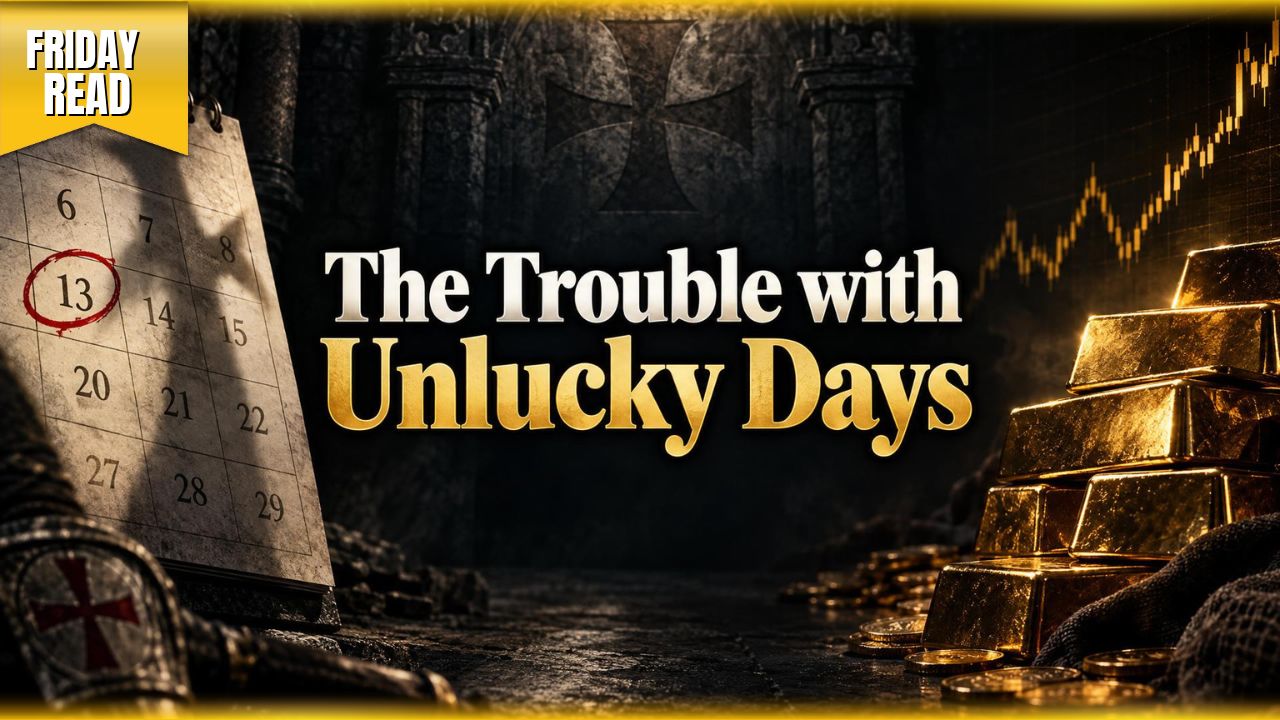
Anyone opening this on Friday the thirteenth with a faint sense of unease is in long-established company, although the company is younger than it likes to think. Friday and the number thirteen were each regarded as unlucky well before anyone thought to combine them, but references to the two together appear only in the late nineteenth century, and the superstition owes much of its popular spread to Friday, the Thirteenth, a 1907 novel by the American stock promoter Thomas Lawson in which a broker exploits the nerves the date produced among traders to engineer a panic on Wall Street. Those of us who write about markets may find it a little humbling that the most famous unlucky day in the calendar was popularised by a financier.
Finance has since returned the compliment by testing whether the date costs anybody money. In 1987 the finance professors Robert Kolb and Ricardo Rodriguez examined 39 Friday the thirteenths between 1962 and 1985 and found that US share returns on those days had been significantly lower than on other Fridays, which they put down to the superstition changing how people behaved rather than to any curse. Later work was less obliging. When Brian Lucey of Trinity College Dublin looked at stock market indices in 19 countries between 1988 and 2000, he found that returns on Friday the thirteenth were generally higher than on other Fridays. Across most markets the supposedly unlucky date turned out slightly better than an ordinary Friday, which is not what anybody frightened of it would have predicted.
The origin story most often told about the date is better known, but the evidence does not support it. At dawn on Friday 13 October 1307, officers of Philip IV of France arrested the Knights Templar across his kingdom, acting on sealed orders sent out a month earlier. The arrests certainly happened; the idea that they gave Friday the thirteenth its reputation is a late twentieth-century embellishment for which historians have found no documentary support. Yet the true episode is more interesting than the myth, because the disaster that arrived on that Friday morning had been years in the making.
The Gold Nobody Wants to Take
The Templars had been founded in the 1120s as an order of warrior monks to protect pilgrims, and by the turn of the fourteenth century they had become one of the most trusted financial institutions in Christendom. They took deposits, moved funds between their houses and lent to princes, and French kings had long used the Paris Temple to keep and administer royal money; Philip created a second treasury at the Louvre in 1295, but the Temple remained part of the crown’s financial machinery. The king’s own finances were another matter. Years of war had been paid for partly by debasing the coinage, and by some estimates the coins in circulation had lost around two-thirds of their value by 1306. When Philip restored a stronger currency that year, those with debts to repay found themselves owing money worth a great deal more than the money they had borrowed, and at the end of December Paris rioted. The king took refuge in the Temple.
Less than ten months later he arrested his hosts. Historians still argue about whether Philip was moved more by money, by his long contest with the papacy over authority or by a sincere if convenient belief in the charges of heresy, and the answer is probably some of each. The financial context is hard to ignore all the same. The king owed the order money, and only the year before he had expelled the Jews of France, seized their property and set royal officials to collect the debts that had been owed to them. The Templars’ goods were seized and inventoried, the pope dissolved the order in 1312 and directed most of its property to the Knights Hospitaller, and the last Grand Master Jacques de Molay was burned in Paris in 1314.
The Templars’ ruin arrived in a single morning, yet nothing that decided it happened on that day. The king’s debts, the damage his coinage had done and the fact that so much of the order’s wealth sat within reach of a man with both a motive and the power to act had all been building for years. The date was simply when the bill arrived.
Investors tend to look at risk the other way round. We remember days, such as the morning a share price halved or the afternoon a price we had watched for weeks finally broke, and gold owners have had plenty of them this year. The price set a record at the end of January, reversed sharply within days and had fallen by more than a quarter by late June, so anyone checking it daily through the spring will have had a run of Fridays that felt distinctly unlucky. Those moves were real, and costly for anybody who had to sell near the bottom. For most people with savings, though, the forces that decide whether wealth holds its value work far more slowly than a daily price chart suggests, and they rarely announce themselves on any particular date.
Philip’s subjects had lived through a version of this. The debasement that cut the value of his coinage by around two-thirds unfolded over years, and the rioting in Paris came when the king abruptly reversed it and debts suddenly had to be repaid in stronger coin. A modern saver faces something similar in milder form. The purchasing power of the currency in which savings are measured has tended to erode gradually, while the price of gold in that currency moves abruptly in both directions, and it is the abrupt moves that make the headlines and keep people awake. Judging gold by its worst days is a little like judging Philip’s currency policy by the riot.
None of this makes a longer view a guarantee. Gold reached $850 an ounce in January 1980, fell to around $252 by 1999 and took almost three decades to regain its old high, so patience alone has not always been rewarded. What a longer view does is change the questions worth asking. Instead of what the price did on Friday, they become what the holding is for, how much of one’s wealth it represents and whether it will still belong unambiguously to its owner in ten or twenty years’ time.
That last question is the one the Templars would have recognised. Their wealth was well guarded against thieves and against any failure of its keepers, and it was lost anyway because it sat within reach of somebody with the power to change the terms on which it was held. For anyone holding physical gold the equivalent questions are prosaic but worth settling: whether the metal is allocated, meaning specific bars identified as the owner’s rather than a claim on a dealer’s general pool; whether whoever stores it is independent of whoever sold it; and whether somebody independent audits it. They are the questions we would encourage readers to put to us or to anyone else. Central banks, which hold gold over decades, pay close attention to the same issue. Between 2013 and 2017 the Bundesbank moved 674 tonnes home from New York and Paris despite having no reason to distrust either institution, which suggests that even the most orthodox holders of gold think hard about who else might be able to reach it.
Friday the thirteenth survives because a date is an easy thing to fear. It gives anxiety a shape and an end, since by Saturday morning the danger has passed. The risks that do most damage to savings rarely keep to a calendar, and the Templars’ own Friday the thirteenth is a fair illustration: the arrests took a morning, while the debts, the debased coinage and the order’s exposure to a powerful debtor had been accumulating for years. Whatever the price of gold does today, the questions that decide whether savings hold their value were answered or left unasked long before it.
Buy Gold Coins

Buy gold coins and bars and store them in the safest vaults in Switzerland, London or Singapore with GoldCore.
Learn why Switzerland remains a safe-haven jurisdiction for owning precious metals. Access Our Most Popular Guide, the Essential Guide to Storing Gold in Switzerland here.
Receive Our Award Winning Market Updates In Your Inbox – Sign Up Here