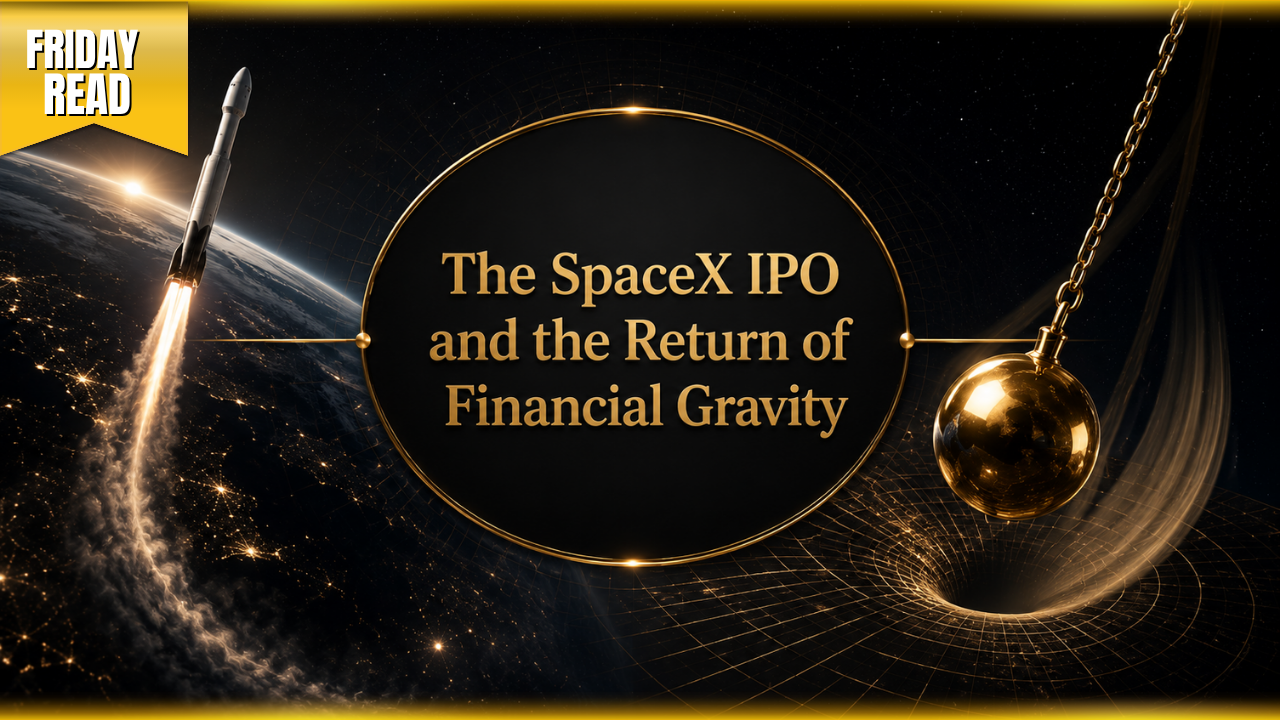
The most interesting thing about the SpaceX IPO is not SpaceX. It is what investors are being asked to believe.
That may sound unfair, because SpaceX is not just some flimsy market confection dreamed up to exploit the latest financial fashion. It has built rockets, launched satellites and changed the economics of space in ways that once seemed wildly improbable. But a good company and a good investment are not the same thing.
At the time of writing SpaceX is set to raise $75 billion in the world’s biggest initial public offering, pricing shares at $135 and securing a valuation that could reach $1.78 trillion if underwriters exercise their option to sell more shares. That would place it among the largest listed companies in the world and one that is so much more than your standard IPO listing with a conventional description. SpaceX is being listed as something much more expansive: a space company, an AI company, an infrastructure company, a satellite company and, above all, a Musk company. In other words, it is being sold as whatever the market is currently most willing to pay for.
We shouldn’t be hasty in our judgement, of course many great companies have evolved from something else: Amazon evolved from an online bookshop, and Apple became much more than a computer company. The trouble begins when flexibility becomes the entire investment case, because at that point investors are no longer valuing a business so much as underwriting a narrative with a share certificate attached.
Should You Sell Your Gold To Buy SpaceX?
The reported valuation implies a company trading at around 92 times its past year’s revenue while still lossmaking, much of this is justified by future markets of enormous scale (artificial intelligence, orbital data centres, enterprise applications) that may, possibly (!) one day produce returns large enough to make today’s price look sensible.
But notice how much trust is being required from the market here… Investors must trust the valuation, the forecasts, the index submission logic, the founder and the banks. They must trust that future cash flows will arrive in sufficient size to justify a present price that already assumes greatness. That is an extraordinary chain of trust, and it is the sort that tends to appear when investors are no longer merely buying growth but buying permission to believe.
Of course SpaceX isn’t really an outlier. Its IPO and valuation has been facilitatedby the ongoing hype and enthusiasm for AI and space technology. Markets are preparing for listings from AI-related giants including OpenAI and Anthropic, with combined potential valuations running into the trillions.
This is how expensive markets become dangerous. Intelligent people start accepting increasingly heroic assumptions as reasonable, decide that caution is a lack of imagination, and conclude that traditional valuation tools are too small for the opportunity. They stop asking what can go wrong because, for several years, the people who asked that question were made to look foolish by rising prices. Then the future arrives late, costs more than expected and produces fewer profits than promised.
This is where gold enters the conversation, it isn’t here as the exciting asset, but as the one which can surprise no one.
Gold has no visionary founder, gives no roadshow presentations, issues no forecasts and claims no multi-trillion-dollar addressable market. It does not pivot into whatever theme the market currently adores, and it has no board, no lock-up expiry, no debt to refinance and no charismatic chief executive explaining why the next frontier will make today’s losses irrelevant. That sounds dull only in a market addicted to narrative. In reality, it is the entire point. When you buy gold, you know what you own: a physical asset outside the corporate promise machine, with no reliance on management, forecasts, banks, analysts, regulators, passive flows or the eternal kindness of the next buyer.
This does not make gold a replacement for enterprise or productive investment, but be clear that it is not supposed to be. Gold is there because markets have a long and distinguished history of taking good ideas, adding cheap money, removing scepticism, inflating the price and then calling the result progress. At moments like this it performs a very unfashionable role: reminding investors that not everything valuable needs a story, and not everything worth holding must depend on exponential growth, flawless execution and a future in which nothing serious goes wrong.
The SpaceX IPO may prove to be a landmark in the commercialisation of space, and public investors may be rewarded handsomely for backing Musk’s most ambitious vision yet. But good investing is not the art of admitting that something is possible; it is the discipline of asking what is probable, what is already priced in and what happens if the world proves less obliging than the prospectus.
Gold owners are often accused of pessimism, when most are simply realists with a long memory. They know that markets periodically convince themselves a new era has arrived, that insiders tend to understand timing rather well, and that liquidity feels permanent until it does not. The point is not to sneer at SpaceX, but to recognise what the excitement around it tells us about the mood of the market. When everyone else is buying a story that requires everything to go right, it is wise to also own something that does not depend on the story at all.
Buy Gold Coins

Buy gold coins and bars and store them in the safest vaults in Switzerland, London or Singapore with GoldCore.
Learn why Switzerland remains a safe-haven jurisdiction for owning precious metals. Access Our Most Popular Guide, the Essential Guide to Storing Gold in Switzerland here.
Receive Our Award Winning Market Updates In Your Inbox – Sign Up Here